
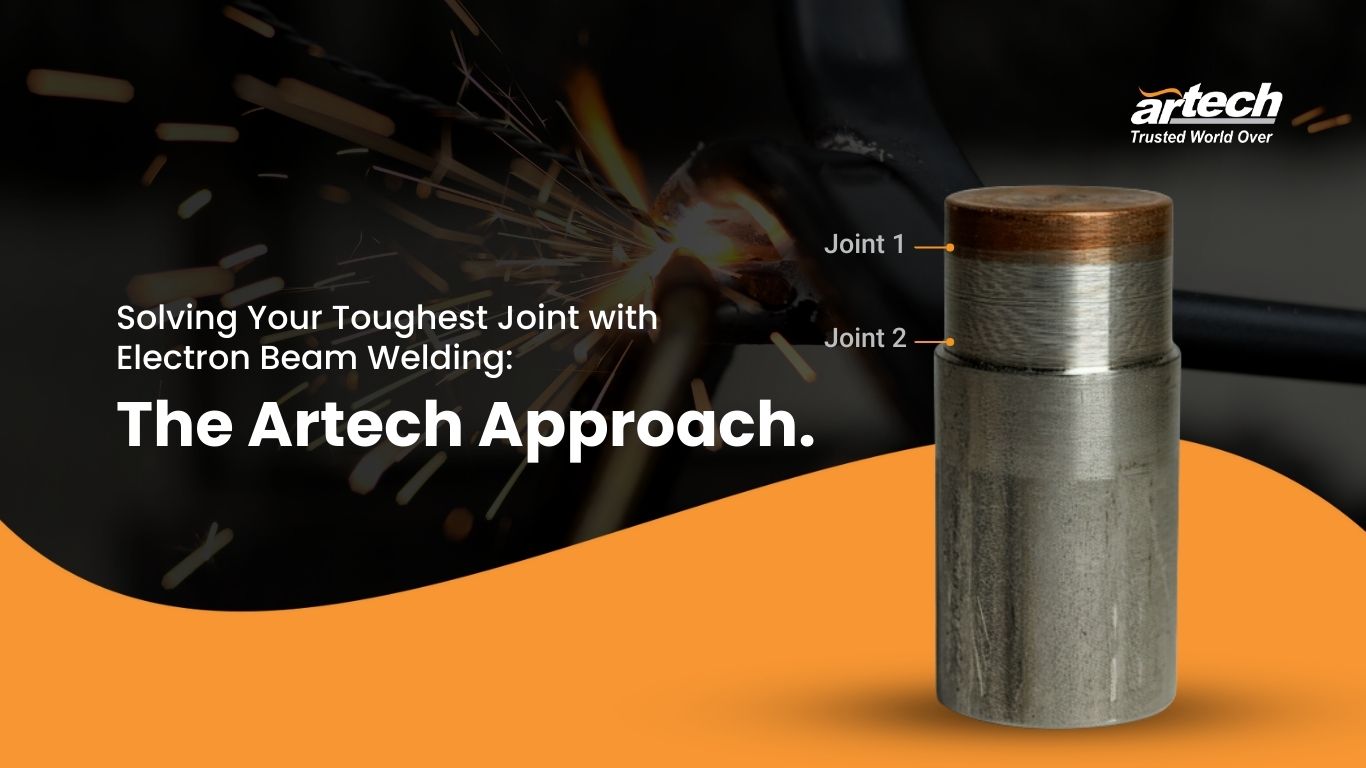
Some components look simple from the outside, but the moment you try to weld them, everything becomes complicated. Different materials, uneven thickness, heat sensitivity, or extremely high-strength requirements make certain joints nearly impossible with regular welding processes. These are the joints that usually burn, deform, crack, or fail during testing.
This is exactly where electron beam welding (EBW) becomes a dependable option. It gives clean penetration, tight control over heat, and stable welds even in the most challenging conditions. The post you shared highlights a component with two different joints stacked in one part each needing a different type of control. For most welding processes, this is a difficult job. EB welding, it is possible, but only when the machine and the process are handled correctly.
Artech has now brought this capability to India, supported by technology transfer from BARC and backed by more than 30 years of welding experience.
Why joints like these difficult to weld
When a part has two joints, each made of different materials or geometries, the welding process needs precision at every layer.
Typical challenges include:
- Different melting points
- Large differences in thermal expansion
- Distortion during heating and cooling
- Risk of weakening the first joint while welding the second
- Limited access or narrow weld zones
Traditional welding puts too much heat into the component. Even if the first joint is welded successfully, the second joint often damages or distorts it.
EB welding avoids this.
How EBW (Electron Beam Welding) handles complex joints
Electron beam welding works with a focused beam inside a vacuum chamber. The heat is concentrated only where the beam strikes, which means the surrounding area stays stable. This is why EBW is effective for multi-joint assemblies.
For a part like the one shown in the post:
- Joint 1 can be welded with deeper penetration and very low heat spread.
- Joint 2 can be welded afterwards without disturbing Joint 1.
- The weld pool remains narrow and controlled.
- The component stays dimensionally stable even after both welds.
Instead of adjusting the part to match the process, EBW allows the process to match the complexity of the part.
Why Artech could solve this joint
Artech’s advantage lies in experience and process discipline. Solving a joint like this requires more than just a machine. It requires an understanding of materials, vacuum levels, beam parameters, and fixturing.
Artech focuses on three essentials:
- Correct beam settings for each joint
- Each layer is welded with a different combination of focus, current, and speed. This prevents overheating and ensures both joints remain structurally strong.
- Stable vacuum environment
- A controlled vacuum keeps impurities away and ensures the joint remains clean, which directly improves weld strength.
- Purpose-built fixturing
- The component must not shift even slightly. Artech designs fixtures that hold the part firmly without introducing stress.
The result is a weld that stays consistent across both joints without warping, cracking, or weakening the component.
A solution built from decades of welding expertise
Artech’s ability to handle difficult parts comes from decades of working with complex welding challenges across industries. EB welding adds another layer to this experience, allowing them to take on assemblies that many manufacturers struggle with.
For companies that need reliable, repeatable welding for multi-joint components, the solution is now available in India. No long lead times. No dependency on overseas centres. No uncertainty about weld quality.
EBW makes the tough joints possible. Artech makes them practical.