
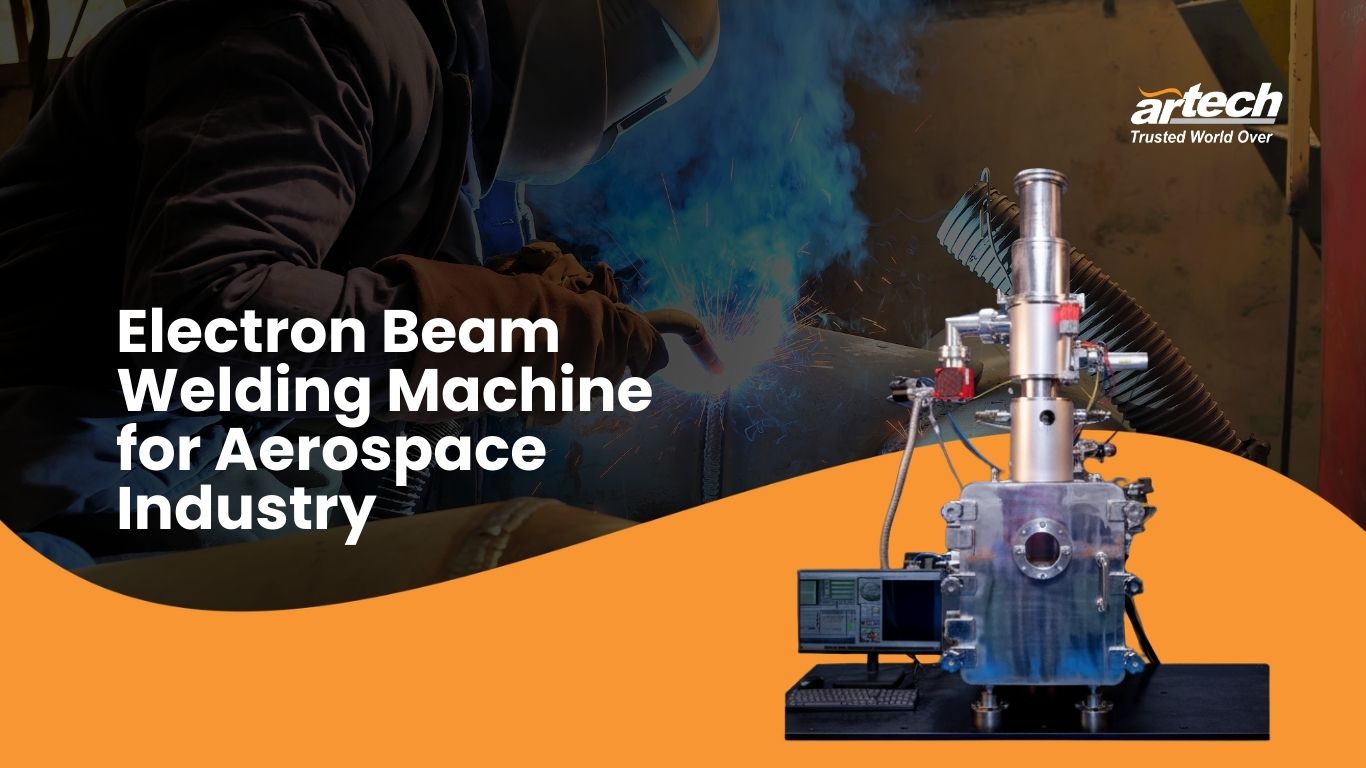
The aerospace industry demands precision, reliability, and zero compromise on quality. Components operate under extreme temperatures, high pressure, and continuous mechanical stress. In such an environment, conventional welding methods often struggle to meet structural and metallurgical expectations.
This is where Electron Beam Welding technology becomes critical.
An advanced EBW Machine offers deep penetration welding, minimal distortion, and superior joint integrity making it one of the most preferred welding processes for aerospace manufacturing.
Why Aerospace Manufacturing Requires Advanced Welding Technology
Aerospace components are not ordinary fabricated parts. They include:
- Turbine components
- Engine casings
- Fuel system parts
- Structural airframe components
- Titanium and nickel-based alloy assemblies
These materials are strong, lightweight, and often heat-sensitive. Welding them requires:
- Controlled heat input
- Minimal contamination
- Deep, narrow weld profiles
- High repeatability
An Electron Beam Welding process meets these requirements with unmatched precision.
What is an Electron Beam Welding Machine?
An EBW Machine uses a focused beam of high-velocity electrons to join materials. The process takes place in a controlled vacuum environment. When the electron beam strikes the workpiece, kinetic energy converts into heat, producing deep penetration welds with minimal heat-affected zones.
Key characteristics of an Electron Beam Welding machine include:
- Operation in a vacuum chamber
- Extremely concentrated heat source
- Narrow and deep weld seams
- Minimal distortion
- Superior metallurgical properties
For aerospace applications, these features are essential rather than optional.
Key Benefits of Electron Beam Welding for Aerospace Industry
1. Deep Penetration Capability
An Electron Beam Welding process can achieve high depth-to-width ratio welds in a single pass. Aerospace parts often require thick-section welding without multiple passes. An EBW Machine handles this efficiently.
2. Minimal Distortion
Aerospace components must maintain dimensional accuracy. The focused nature of Electron Beam Welding reduces overall heat input, limiting warping and post-weld corrections.
3. Welding of Reactive Materials
Materials such as titanium and specialized alloys are commonly used in aerospace. Since the EBW Machine operates in vacuum, oxidation and contamination are significantly reduced.
4. High Structural Integrity
Electron Beam Welding produces clean welds with low porosity. This ensures structural reliability a non-negotiable factor in aerospace manufacturing.
5. Repeatability and Process Control
Modern EBW Machine systems allow parameter control, beam stability, and automated cycles, ensuring consistency across production batches.
Applications of EBW Machine in Aerospace
Electron Beam Welding machines are widely used for:
- Jet engine components
- Aerospace transmission systems
- Pressure vessels
- Sensor housings
- Satellite components
- Cryogenic assemblies
The ability of Electron Beam Welding to handle precision assemblies makes it suitable for both defense and commercial aviation sectors.
Why Conventional Welding Falls Short in Aerospace
Traditional welding processes often introduce:
- Wider heat affected zones
- Surface oxidation
- Multi-pass weld inconsistencies
- Higher residual stress
In aerospace, even small inconsistencies can lead to performance risks. An EBW Machine eliminates many of these concerns by delivering controlled energy input and superior weld quality.
Choosing the Right Electron Beam Welding Machine for Aerospace
When selecting an EBW Machine for aerospace applications, consider:
- Chamber size and component capacity
- Beam power range
- CNC integration
- Vacuum system reliability
- Process monitoring and documentation capability
A well-engineered Electron Beam Welding setup ensures compliance with aerospace quality standards and traceability requirements.
The Future of Electron Beam Welding in Aerospace
As aerospace designs become lighter, more compact, and performance-driven, the need for advanced joining processes will increase. Electron Beam Welding technology continues to evolve with improved automation, digital monitoring, and enhanced beam control.
The role of the EBW Machine in aerospace manufacturing is expected to grow in:
- Electric aviation systems
- Space exploration hardware
- Lightweight structural assemblies
- High-performance propulsion systems
The aerospace industry cannot rely on compromise when it comes to welding technology. Electron Beam Welding provides the precision, penetration, and process control required for mission-critical components.
An advanced EBW Machine is more than a welding system, it is a strategic manufacturing asset for aerospace applications.
For manufacturers aiming to meet global aerospace standards, Electron Beam Welding remains one of the most reliable and technically superior joining solutions available today.