
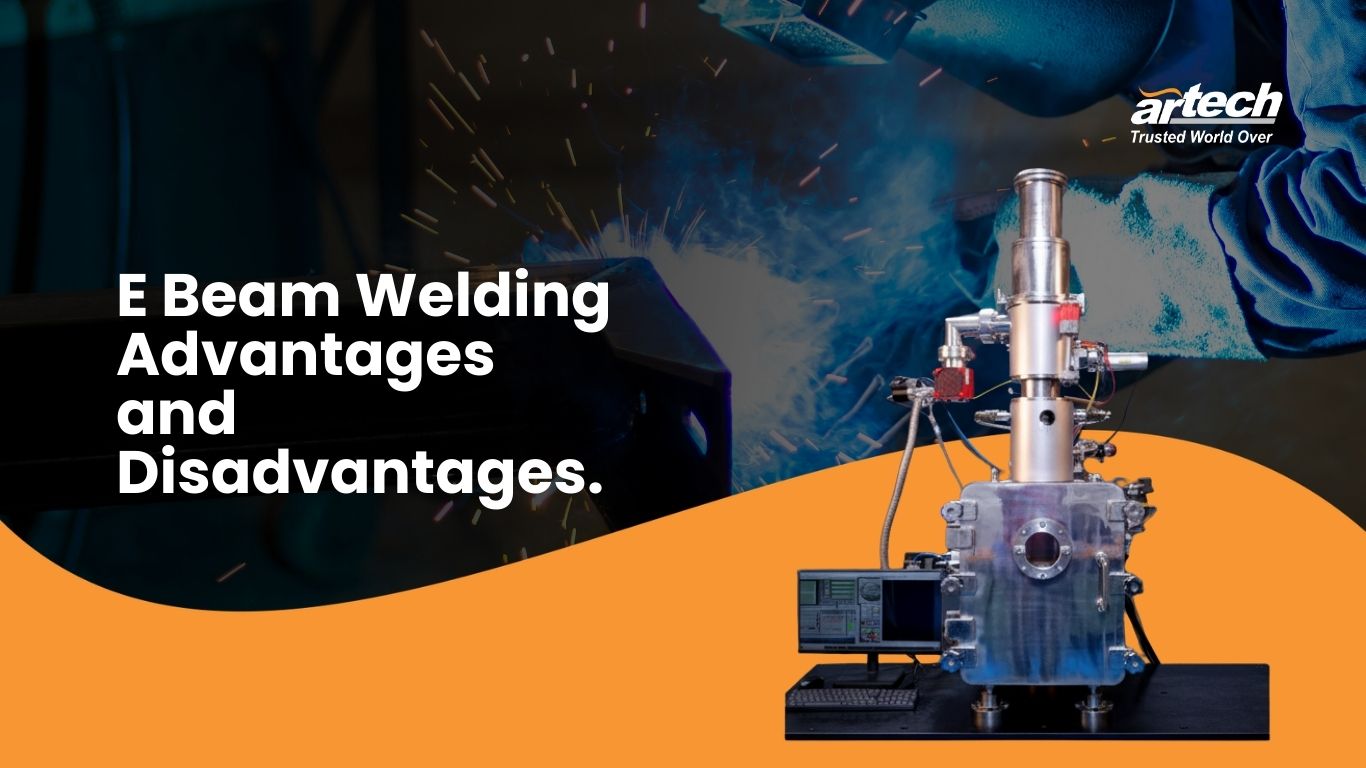
E Beam Welding, also known as Electron Beam Welding (EBW), is a high-precision fusion welding process used in aerospace, automotive, defense, nuclear, and high-performance manufacturing sectors.
It is known for deep penetration, minimal distortion, and superior weld quality. However, like every advanced manufacturing process, it comes with both advantages and limitations.
This blog explains the advantages and disadvantages of E Beam Welding in a practical and technical manner.
What is E Beam Welding?
E Beam Welding is a process where a focused beam of high-velocity electrons is directed onto the workpiece. The kinetic energy of the electrons converts into heat upon impact, creating a molten weld pool.
The process typically takes place inside a vacuum chamber to prevent electron scattering and contamination. This controlled environment allows extremely precise and deep welds.
Advantages of E Beam Welding
1. Deep Penetration Welding
One of the biggest advantages of E Beam Welding is its high depth-to-width ratio. Thick sections can often be welded in a single pass, reducing processing time and ensuring uniform joint strength.
2. Minimal Heat Affected Zone
Because the electron beam is highly concentrated, the surrounding material receives limited heat. This results in:
- Reduced distortion
- Better dimensional accuracy
- Lower residual stress
This makes E Beam Welding suitable for precision components.
3. Superior Weld Quality
EB Welding produces clean welds with:
- Low porosity
- Minimal contamination
- Strong metallurgical bonding
The vacuum environment further enhances weld integrity, especially for reactive metals.
4. Suitable for Dissimilar Metals
E Beam Welding can join different materials with varying thicknesses. It is commonly used for titanium, stainless steel, nickel alloys, and specialized aerospace materials.
5. High Repeatability and Automation
Modern EB Welding systems allow parameter control, beam positioning accuracy, and programmable cycles. This ensures consistent weld quality across production batches.
6. Reduced Post-Weld Processing
Since distortion is low and welds are precise, secondary machining and correction work are significantly reduced.
Disadvantages of E Beam Welding
1. High Equipment Cost
EB Welding machines require vacuum systems, electron guns, and advanced control systems. The initial investment is significantly higher than conventional welding methods.
2. Vacuum Requirement
Most E Beam Welding operations require a vacuum chamber. This can limit the size of components unless specialized large-chamber systems are used.
3. Limited Accessibility
The process generally requires line-of-sight access for the electron beam. Complex geometries may require repositioning or special fixturing.
4. Skilled Operation Required
Operating and maintaining E Beam Welding equipment requires technical expertise. Improper parameter settings can affect weld penetration and quality.
5. Production Setup Time
Creating a vacuum environment adds cycle time compared to open-atmosphere welding processes. For very high-volume production of simple parts, this may be a consideration.
Where EB Welding is Most Effective
Despite its disadvantages, E Beam Welding is ideal for applications where:
- Weld integrity is critical
- Deep penetration is required
- Distortion must be minimal
- Reactive materials are used
- Precision is mandatory
Industries that commonly use EB Welding include:
- Aerospace
- Defense
- Nuclear
- Automotive powertrain manufacturing
- Medical device manufacturing
When to Consider Alternatives
If the application involves:
- Low-precision structural fabrication
- Very large components without vacuum capability
- Budget constraints for high capital equipment
Other welding processes may be evaluated.
Understanding the advantages and disadvantages of E Beam Welding helps manufacturers make informed decisions.
EB Welding offers deep penetration, minimal distortion, and high structural integrity. At the same time, it requires significant investment, vacuum systems, and skilled operation.
For critical and high-performance components, the benefits of E Beam Welding often outweigh the limitations. The process remains one of the most advanced and reliable welding technologies available today.