
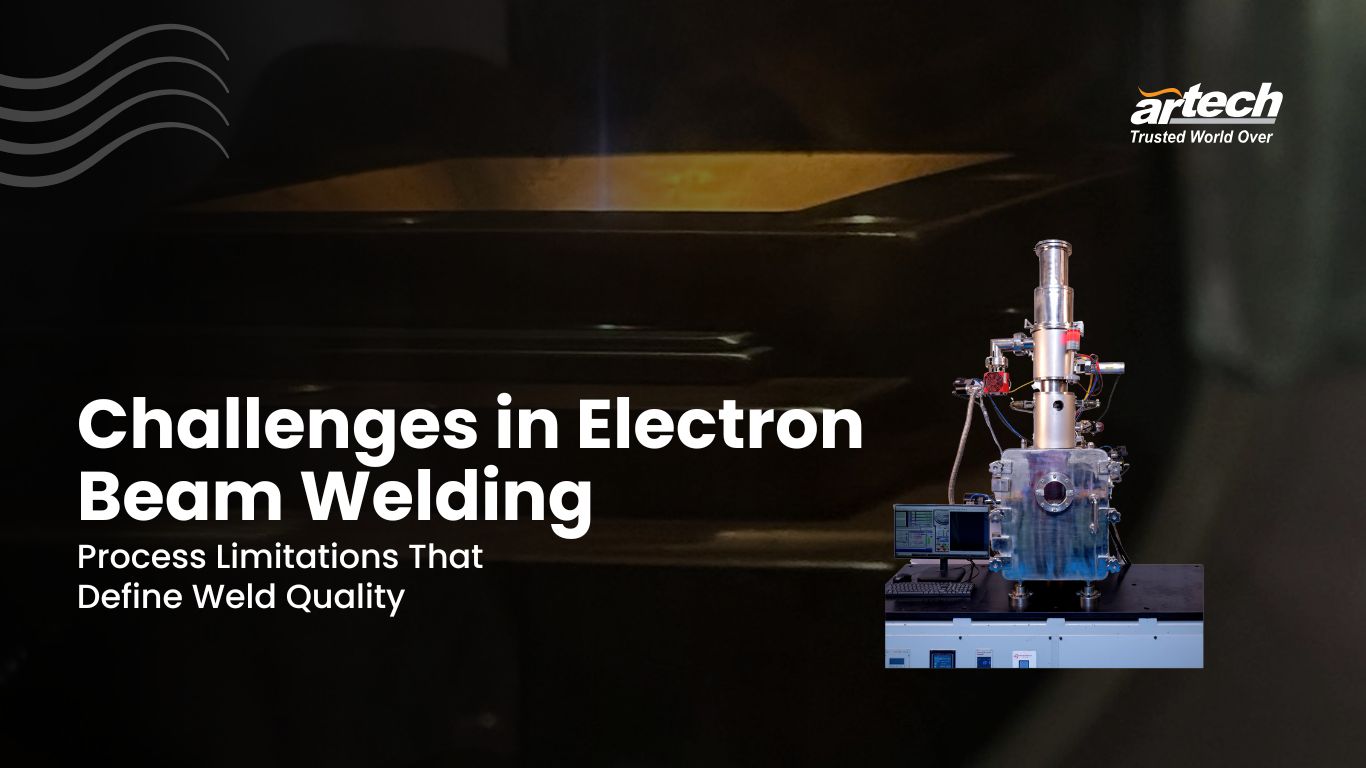
Electron Beam Welding (EBW) is often know as EBW selected for applications where precision, penetration depth and metallurgical integrity are critical.
Its ability to deliver deep, narrow welds with minimal heat input makes it indispensable in aerospace, automotive, nuclear and high-performance engineering applications.
However, these same strengths make EBW one of the most process-sensitive welding technologies in manufacturing.
Unlike conventional welding methods, EBW does not tolerate approximation. Every variable from vacuum quality to beam control directly defines weld integrity.
Vacuum Dependency: The Foundation of EBW
Electron Beam Welding operates in a high-vacuum environment to allow stable beam generation and penetration.
This creates a fundamental challenge:
the welding process is entirely dependent on vacuum integrity.
Even small pressure variations can:
- Scatter the electron beam
- Reduce penetration consistency
- Introduce weld instability
Vacuum management is not a support function in EBW, it is a core process requirement.
Extreme Sensitivity to Process Parameters
EBW reacts sharply to changes that would be insignificant in other welding processes.
Parameters such as:
- Beam current
- Focus position
- Accelerating voltage
- Welding speed
must remain tightly controlled.
Minor deviations can result in lack of fusion, internal porosity, or excessive keyhole instability.
This sensitivity is both EBW’s strength and its greatest challenge.
Material and Geometry-Driven Behaviour
Electron Beam Welding does not behave uniformly across components.
Material composition, thermal conductivity, joint geometry, and thickness variations significantly influence:
- Keyhole formation
- Weld pool stability
- Cooling rates
This means EBW cannot rely on standardised settings.
Each application demands component-specific process development.
Validation Is Not Optional
EBW does not allow direct transition from drawing to production.
The process demands:
- Trial welds
- Parameter optimisation
- Metallurgical validation
Skipping or compressing this stage increases the risk of internal defects that are difficult to detect post-weld.
Validation time is often underestimated and is one of the biggest challenges for EBW adoption.
Engineering Happens Before the Weld
One of the least understood challenges in Electron Beam Welding is that most failures originate before welding begins.
Joint design, fixturing strategy, beam accessibility, and thermal planning determine weld success long before the beam is switched on.
In EBW, the machine executes the weld but engineering defines the outcome.
Electron Beam Welding delivers unmatched performance, but only when its challenges are fully understood and engineered around.
EBW is not limited by the machine.
It is limited by the depth of process understanding behind it.