
Welding dissimilar metals is one of the most common challenges in manufacturing, and also one of the most misunderstood. On paper, the job may look simple: two metals, one joint. But the moment heat enters the picture, the differences between the materials start working against you. Their melting points, thermal expansion, conductivity and metallurgical behaviour rarely match. This is why most traditional welding processes struggle with cracks, porosity, distortion, or weak bond strength when two different metals must be joined.
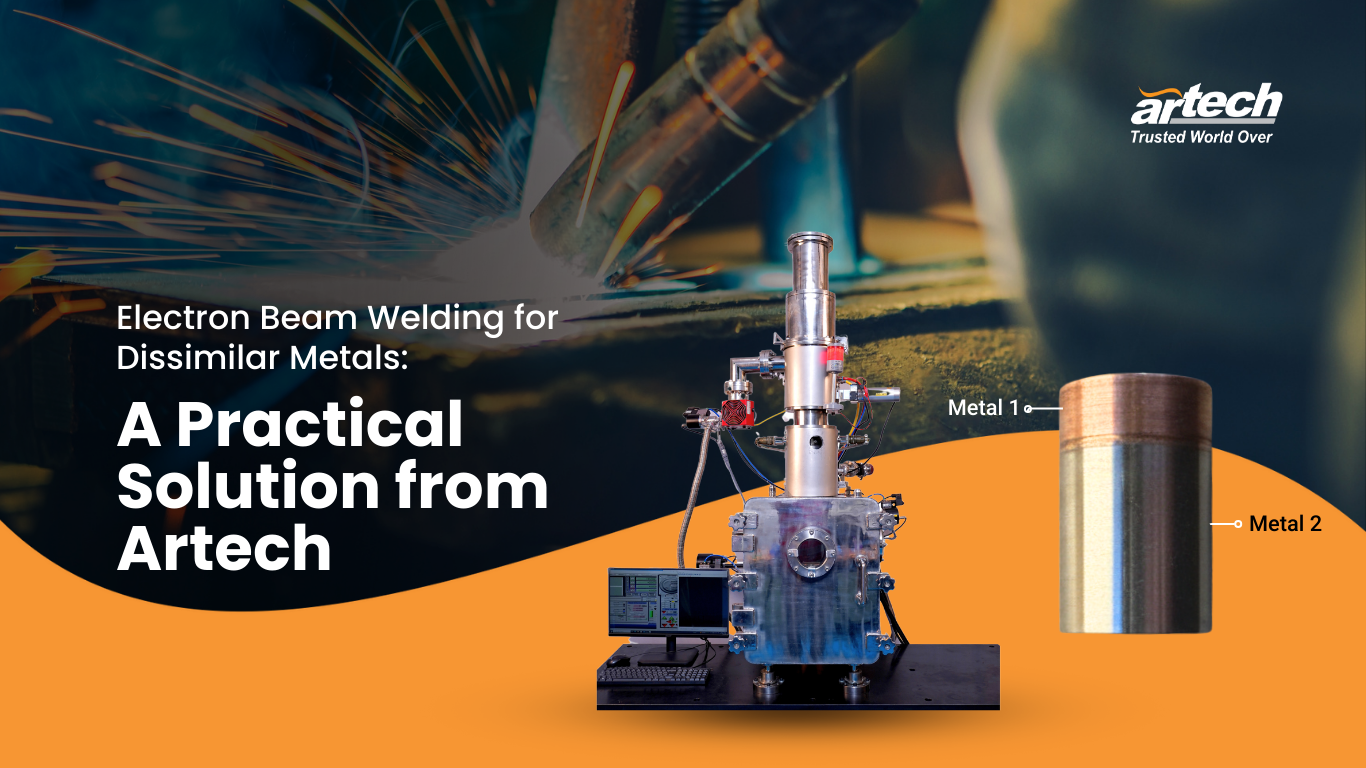
This is where electron beam welding (EBW) becomes a reliable option. The post highlights exactly this: a copper-to-steel weld that stays clean, straight and stable. Such a joint is difficult with conventional methods but achievable with EB welding when the process is handled correctly.
Artech brings this capability to Indian manufacturers, backed by decades of experience with difficult welds.
Why dissimilar metal welding is complicated
Every metal reacts differently to heat.
When two metals are joined:
- One expands faster than the other.
- One melts earlier than the other.
- One may form brittle compounds at the interface.
- One may pull heat away too quickly, causing incomplete fusion.
This uneven behaviour leads to common failures such as:
- Weak bonding
- Cracks along the interface
- Warping or distortion
- Excessive heat-affected zones
- Poor appearance and inconsistent quality
Traditional welding methods often require preheating, filler metals, or complex setups just to reduce these problems. Even then, consistency is difficult.
Electron beam welding solves these issues by changing how heat is applied.
How EB Welding handles dissimilar metals better
Electron beam welding uses a focused beam in a vacuum chamber. The beam heats only a narrow zone, so both metals melt at the interface without affecting the surrounding areas.
For dissimilar metal welding, this brings clear advantages:
- Minimal heat input prevents distortion.
- The joint forms cleanly without filler material.
- The vacuum environment avoids contamination.
- The narrow weld zone limits brittle phases from forming.
- Both metals bond at the exact point where they need to, without excess melt.
Instead of forcing both metals to behave the same, EBW works with their differences.
Artech’s approach to dissimilar metal EB welding
A successful dissimilar metal weld depends on process control more than anything else. Artech approaches it through three critical steps.
- Understanding the material combination
- Every pair of metals behaves differently. Artech studies how each metal responds to beam energy, heating rate, and cooling rate before deciding the parameters.
- Controlled beam penetration
- Too much penetration can cause one metal to dominate the joint. Too little can create weak bonding. Artech adjusts focus and current to suit each combination.
- Fixturing built for accurate alignment
- Dissimilar metals may be rigid on one side and soft on the other. Artech designs fixtures that hold both sides firmly without stress.
The result is a weld that stays straight, clean, and strong even when the metals are fundamentally different.
A reliable solution for industries that cannot afford failure
From electrical connectors to aerospace components, many industries rely on dissimilar metal joints. The performance of the final assembly often depends on this one weld. EB welding ensures that the joint not only holds but holds reliably, batch after batch.
With us offering electron beam welding in India, companies no longer need to depend on external suppliers or overseas facilities for such critical work. They get a controlled, repeatable, and high-quality welding method backed by more than 30 years of expertise.
Dissimilar metals may behave differently, but with EBW, they can still work together.