
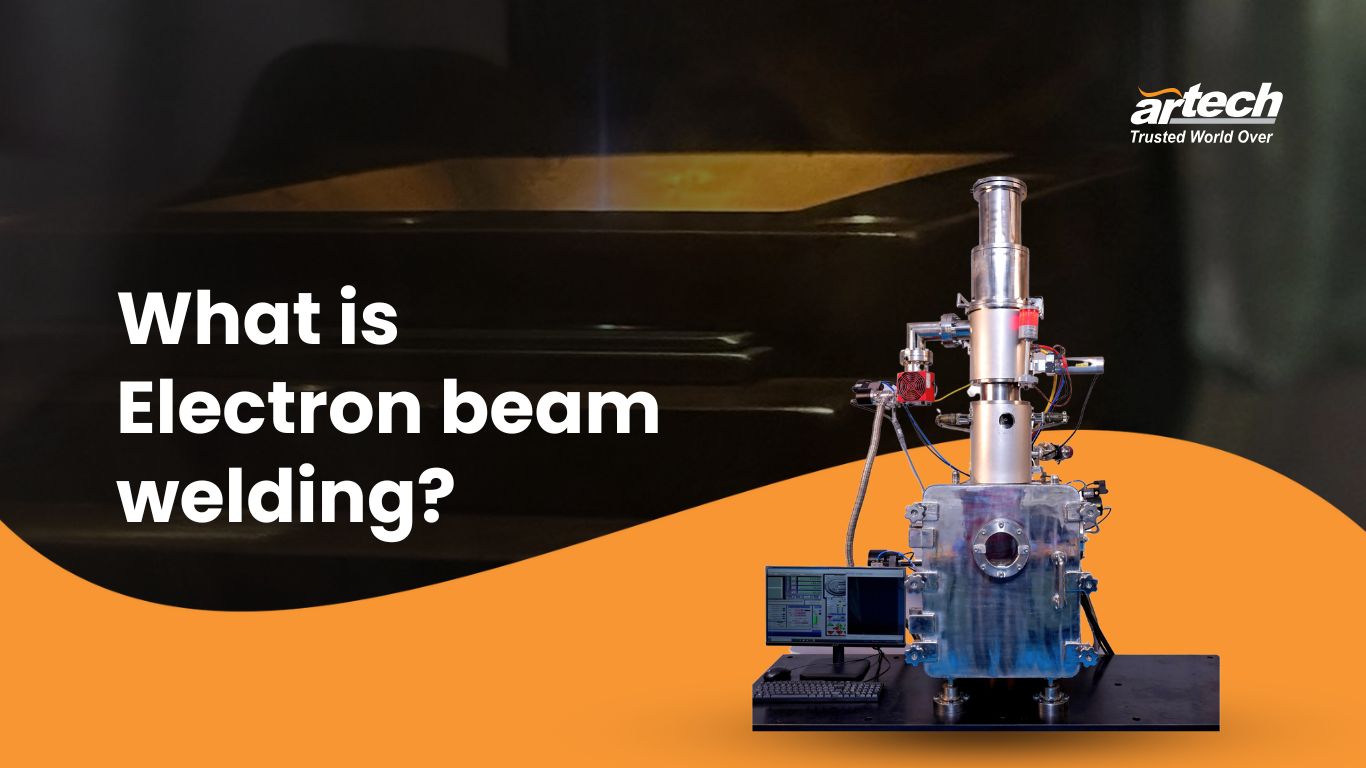
Know Electron Beam Welding
Electron Beam Welding, commonly referred to as EB welding and EBW, is a precision welding process used to join metal components using a focused beam of high-speed electrons. Unlike conventional welding methods that rely on arcs or flames, EBW generates heat through the kinetic energy of electrons striking the metal surface.
When the electron beam contacts the workpiece, this energy is converted into heat, melting the metal and forming a weld joint. Because the energy is highly concentrated, the weld is narrow, deep, and accurately controlled.
The Principle Behind EB Welding
The fundamental principle of electron beam welding lies in energy concentration. Electrons are accelerated to very high velocities and focused into a fine beam. When this beam impacts the metal, it delivers intense heat to a very small area.
This focused energy allows the metal to melt quickly while limiting heat spread to surrounding areas. As a result, EBW produces deep penetration with minimal thermal distortion.
Role of the Vacuum Environment
Electron Beam Welding is performed in a vacuum chamber. This environment is essential for the process to function correctly.
The vacuum allows electrons to travel freely without colliding with air molecules, ensuring that the beam remains focused and powerful. It also prevents oxidation during welding, which contributes to clean and consistent weld quality.
Beam Generation and Control
Within the EBW system, an electron gun generates electrons that are accelerated using high voltage. Magnetic lenses then focus and direct the electrons into a precise beam.
The beam parameters can be adjusted to control weld depth, width, and penetration. This level of control is one of the key reasons EBW is used for critical and high-precision components.
Heat Application and Weld Characteristics
One of the defining features of electron beam welding is how heat is applied to the material. The energy density of the electron beam is extremely high, allowing deep weld penetration in a single pass.
Because heat is concentrated only at the joint, the heat-affected zone remains small. This results in reduced distortion and maintains the dimensional accuracy of the component.
Material Compatibility
EB Welding can be used to join a wide range of metals, including carbon steels, stainless steels, aluminium, titanium, copper alloys, and nickel-based materials. It is also suitable for welding dissimilar metals when precise control is required.
Typical Industrial Applications
Due to its precision and reliability, EBW is commonly used in industries such as aerospace, automotive, defence, medical devices, and precision engineering. It is particularly suited for applications where weld integrity and repeatability are critical.
Conclusion
Electron Beam Welding is a highly controlled welding process that uses a focused electron beam in a vacuum environment to create deep, clean, and precise welds. Its ability to deliver concentrated heat with minimal distortion makes it an essential process for high-value and precision-driven applications.