
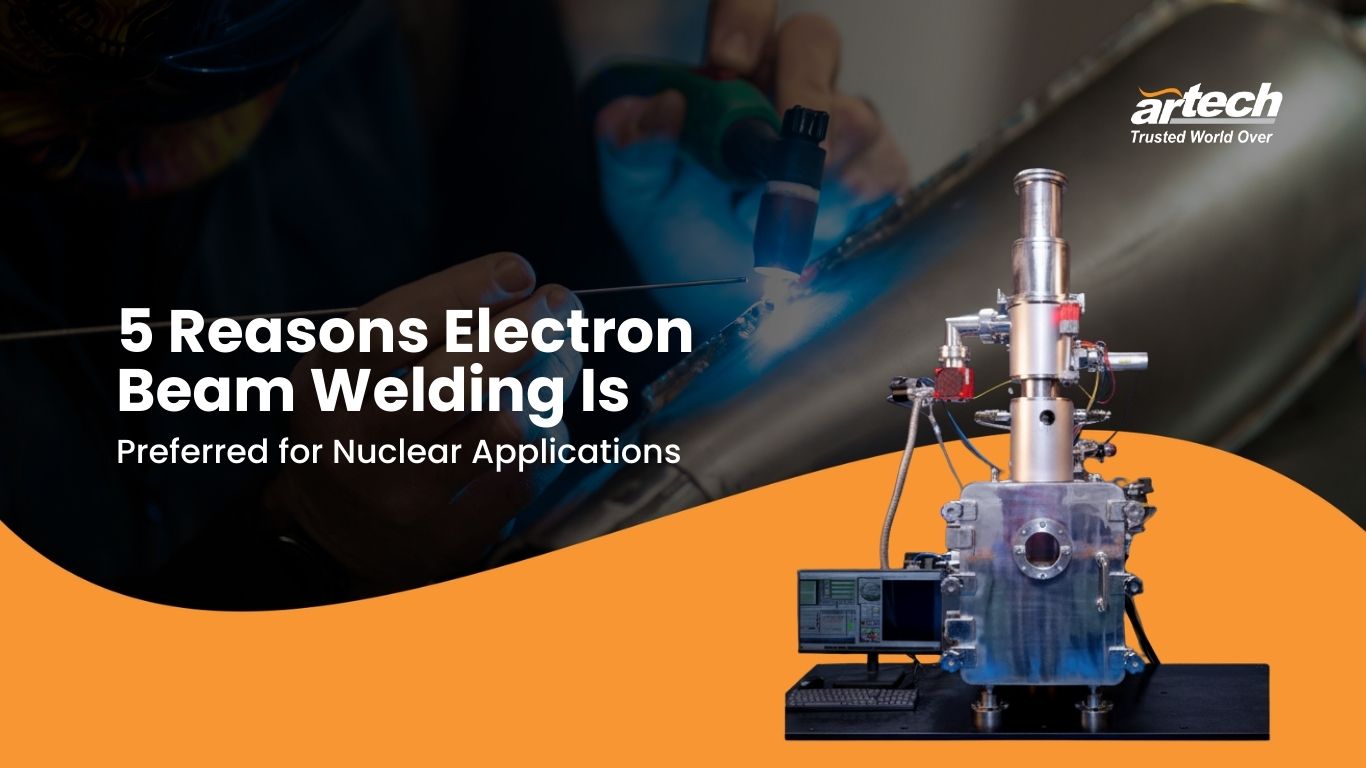
In nuclear applications, welding performance is judged over long service life under extreme operating conditions. Processes must deliver defect-free joints, stable material properties and predictable performance.
Electron Beam Welding meets these demands due to a set of process-level advantages that directly address nuclear application requirements.
Reason 1: Defect-Free Welding in a Vacuum Environment
Electron Beam Welding is performed in a controlled high-vacuum environment. This eliminates atmospheric contamination during welding, reducing the risk of porosity, inclusions, and internal defects critical for nuclear-grade components.
Nuclear applications demand welding processes that prioritise integrity, predictability, and longevity. Electron Beam Welding delivers these advantages through precise energy control, vacuum operation, and minimal thermal impact making it a preferred choice for nuclear components.
Reason 2: Leak-Tight, Fully Penetrated Joints
EBW enables deep, narrow penetration in a single pass. This allows complete fusion across joint thickness, producing leak-tight welds required for pressure-containing and safety-critical nuclear components.
Reason 3: Minimal Heat Affected Zone
High energy density combined with low overall heat input results in a narrow Heat Affected Zone. This limits microstructural changes in the base material and helps preserve mechanical properties.
Reason 4: Reduced Residual Stress and Distortion
Lower heat input reduces thermal gradients during welding. This helps control residual stresses and minimises distortion, improving dimensional stability in complex nuclear components.
Reason 5: Long-Term Reliability Under Service Conditions
Controlled metallurgy, preserved material properties, and stable weld integrity support reliable performance over long service life essential in nuclear applications where repair or replacement is difficult.